Since there's a paywall, I copied and pasted this story from The Athletic. I live in the Tri Cities and had read something similar on the weekend before SB 48. Prior to his becoming an NFL QB, Russell Wilson was a baseball player for the local Class A team. It's a long article, but I think it's worth reading as it explains why I started out as being such a big Russell Wilson fan. The copy and pasted portion is in bold:
The Tri-Cities — Pasco, Kennewick and Richland — are located where the Yakima, Snake and Columbia Rivers meet, about 200 miles southeast of Seattle. Days after he was drafted, Wilson boarded a flight into Tri-Cities Airport, where he was greeted by Dust Devils general manager Derrel Ebert.
Dust Devil players live with local host families free of charge, and Wilson lived with Dana Brunsdon, who owned a three-bedroom ranch house in Kennewick, reserving one bedroom for players. Only, Brunsdon was already hosting one, third baseman Dominic Altobelli, meaning either he or Wilson would have to use Brunsdon’s air mattress for the summer.
“I walked in there and I said, ‘OK guys, if you want to take turns using the bed and the air mattress, I’ll wash the sheets every time you go on the road,'” Brunsdon recalled. “Dominic took one look at Russell and said, ‘He’s a rookie.’
“Then I went, ‘OK, I think I’ll leave this up to you guys.’ And I left the room.”
Just about every aspect of Wilson’s life as a minor leaguer stands in stark contrast to his current life as a jet-setting superstar quarterback — the average salary for Dust Devils was approximately $1,100 a month. Players were responsible for feeding themselves, and the health-conscious Wilson made sure to avoid the frozen-food diets his teammates ate. (Brunsdon remembers Wilson being quite the cook, and jokes that he still owes her a plate of his signature macaroni and cheese.)
Instead of chartered flights across the country, there were buses, with players sitting shoulder-to-shoulder on long rides to Boise or Vancouver. After night games on the road, players would dine at late-night spots such as Denny’s, grab snacks from the nearest convenience store or hit the closest fast-food chain using their $15 meal per diem. (After Seahawks home games these days, Wilson and Ciara frequent the upscale Metropolitan Grill, where Wilson is sometimes applauded as he enters.)
“It was about as pedestrian a lifestyle as you could imagine,” said Mike Boyle, former Dust Devils radio broadcaster.
At Brunsdon’s house, Wilson kept to himself. He studied his NC State football playbook and read his Bible. He talked often with his family out east. He didn’t party or hit the bars with teammates, and if he did, he didn’t drink.
“He definitely held himself to a higher standard, which I think everybody respected,” said former Dust Devils catcher Bryce Massanari, who was so fond of Wilson’s manners, discipline and demeanor that he once joked to his father that Wilson could be President of the United States if he put his mind to it.
“I really believe that,” Massanari said. “I just think he’s a wonderful person.”
Wilson was so reserved that early on during his stay, Brunsdon and Altobelli grew concerned. After speaking with Wilson, they learned that the day after he was drafted by the Rockies — just days before he was supposed to report to Tri-City — his father, Harrison Wilson III, died from complications of diabetes. Some teammates were aware of the situation, but out of respect for Wilson’s privacy, they chose not to press the issue. Brunsdon remembers Wilson telling her that his mother and other family members were helping him through his grief.
“After Dominic talked to him about it, we kind of got to know him more,” Brunsdon said. “He slowly came out.”
Altobelli became one of his closest friends on the team, with the pair riding to the ballpark together in Altobelli’s car.
Outside of that conversation at home, those around Wilson don’t recall him opening up about his father. But in an interview with former Tri-City Herald beat writer Jack Millikin, Wilson discussed how influential his father was — and how he felt Harrison’s presence that summer in Pasco.
“When you play in Tri-Cities there’s some hills off in the distance when you’re looking out at home plate,” Millikin said. “It’s really kind of a nice view, and Russell talked about looking at those hills and thinking about his dad looking down from those hills, looking at him with pride about what he’s doing. That did leave an impression on me.”
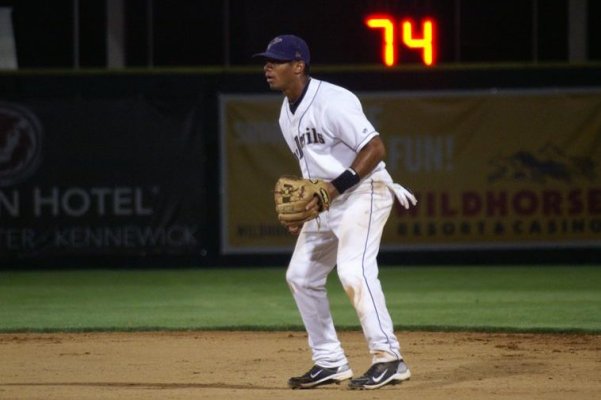
As a prospect, Wilson wasn’t as polished as teammates who played the sport full-time. He came with unquestionable athleticism, but his skills at the plate needed to be sharpened. He was a powerful player, though not necessarily a power hitter. He was a smooth baserunner, just not exactly adept at getting on base. Wilson knew this. Even if he didn’t have the most talent, he’d put in the most hours at work.
Wilson spent a great deal of time with hitting coach Anthony Sanders. The same went for catcher Massanari, whose Georgia Bulldogs had eliminated Wilson and NC State in a 2008 NCAA Super Regional before the pair reconnected in Pasco and then again with Class-A Asheville in 2011.
“Anything we had to be at he was going to be the first one there, no doubt about it,” Massanari said. “I think we had mandatory three days a week we had to be at the gym. He was going to be there early, he was going to be there late. If it was the (batting) cage, he was never going to be the first one to leave the field. He was one of the last guys to get out of there and one of the first guys to get there every day.”
If the Dust Devils were scheduled to play a night game, Wilson would be there at noon — the same time as the coaching staff — to field grounders or work on his swing. In addition to mandatory infielder practices, Wilson would schedule individual sessions with other members of the staff. Anything deemed “optional” seemed mandatory in Wilson’s mind.
He did his due diligence away from the field as well, pestering the coaching staff for additional information on opposing pitchers to add to his own research.
“You probably can’t find many people who prepare as well as he does for games,” said Josh Rutledge, the team’s shortstop in 2010 and Wilson’s road roommate. “And he takes practice really seriously.”
The results weren’t necessarily tangible: In 32 games, Wilson posted a less than pedestrian slash line of .230/.336/.377 with 11 RBIs. Still, his effort earned him a reputation as the most dedicated worker on the roster.
The highlight of Wilson’s summer at the plate was his first professional home run. Gesa Stadium is where well-hit balls go to die. Home runs are few and far between. If the Dust Devils have 38 home games in a season, the team would be fortunate to tally 10 in a season. Wilson’s first came on a frozen rope to left field against Salem-Kizer on July 11.
“It was such a line drive that you figured ‘Uh oh, it’s going to be extra bases,’ but it got out over the wall,” Boyle said. “He could hit the ball hard. He had some power and some pop to his bat.”
Wilson hit another the next day.
“He had a lot of power and generated a lot of torque when he was swinging,” said Rutledge, who played six seasons in the big leagues before retiring last year. “He was definitely getting better throughout his time playing there.”
An everyday starter at second base, Wilson was determined to master the art of turning double plays. In fact, Jay Matthews, the scout responsible for Colorado drafting Wilson, has often told the story of linking up with Wilson in his hometown of Richmond, Va., the same day Harrison died — at Russell’s request. In what has been described as both a therapeutic and an instructional experience, Matthews and Wilson practiced for hours at an indoor facility, setting the foundation for Wilson to become a quality infielder in his upcoming minor-league stint. Wilson kept at it in Pasco. He’d hit the field before, during and sometimes after batting practice.
“He got really good,” former Dust Devils manager Fred Ocasio said of Wilson, who turned 14 double plays and committed just one error in 2010. “He figured it out and was able to do it.”
Nothing about Wilson’s work habits surprised Ocasio. He nabbed an early scouting report from Tom Holliday, Ocasio’s pitching coach when Ocasio played at Oklahoma State in the early 90s. Holliday spent three years with Wilson at NC State in the same position, and after the draft, he informed Ocasio of the type of player he’d be getting. “Once he got there, he showed me that with his actions,” Ocasio said. “Every day he was doing something.”
What has become one of Wilson’s many taglines was, apparently, a mantra long before Russell Wilson was a household name.
“He was at the park quite a bit,” Brunsdon said. “I don’t think he ever slept, and when he came up with that motto — ‘No time to sleep’ — I thought, There are no truer words.”
Wilson wanted to model his professional career after two-sport stars such as Brian Jordan, Deion Sanders and Bo Jackson. Those in Pasco remember Wilson solely focused on being the next two-sport stud.
“Russell was looking to follow in those footsteps, and he really believed he was going to do that,” Millikin said. “There was no doubt in his mind.”
And despite his struggles at the plate, Wilson wasn’t the only one who thought he had a legitimate chance at the majors.
“You could tell he was really raw in everything that he did, from how he swung to how he fielded ground balls and just all the baseball actions that you would see from somebody that’s advanced,” said Sanders, now the outfield and baserunning coordinator for the Rockies’ minor-league system. “He had some work that needed to be done. But he was on the right path.”
In Asheville the following summer, Massanari and Wilson spent hours in the cages together, taking turns filming each other’s at-bats and exchanged advice. Massanari remembers being in the Asheville clubhouse when Wilson told teammates he was giving up baseball to pursue football full-time — and that he would transfer from NC State and play his senior season at Wisconsin.
The Tri-Cities are already flooded with Seahawks fans, but in 2011 many also became Badgers fans, cheering on Wilson from afar as he led Wisconsin to the Rose Bowl. “Holy cow, this guy is unbelievable,” Massanari would think on Saturdays while watching his former teammate play his way into the top-10 of that year’s Heisman voting. Brunsdon, a longtime Seahawks fan, was so enamored of her former boarder that in April 2012 she tweeted Pete Carroll and encouraged the team — coming off a 7-9 season with Tavaris Jackson at QB — to draft Wilson.
“He probably didn’t even read it, but I remember thinking I got to tell him how great he is,” she said. “I kept telling everybody, ‘This is perfect — it would be perfect if he came here. We need him.’ Of course, I was absolutely shocked when he got drafted.”
Seattle selected Wilson with the 75th overall pick in the third round — and Brunsdon had a call to make.
“When he made it to the Seahawks, I called up Dominic and said, ‘You made him sleep on the air mattress! He’s never going to talk to us again!'” she recalled, laughing. (Don’t worry, they’ve spoken since.)
While Wilson was working his way up the Seahawks depth chart, the Tri-Cities faithful viewed him as a prized alumnus. That summer of 2012 was current Dust Devils broadcaster Chris King’s first season on the job. He remembered the biggest story in town that season being about the former Dust Devils player who was drafted by the Seahawks, but because of the three-year, $19 million deal Seattle gave free-agent Matt Flynn months earlier, it felt like a longshot Wilson would actually play early in his NFL career.
As King recalls, the local storyline progressed like this: First, Wilson might be the backup quarterback. Then in training camp, Wow, they’re saying it’s an open competition. Weeks later, it turned into, He’s playing well in these preseason games, he may have a shot. By the end of the preseason, reality set in: Wilson — essentially a native son of the Tri-Cities at this point — was going to quarterback the Seahawks.
Two seasons later Wilson and the Seahawks won the Super Bowl and Wilson was no longer a notable Dust Devil alum — he was the Dust Devil alum.
“When you’re playing with somebody in minor-league baseball, you don’t think they’re going to win a Super Bowl two years later,” Massanari joked. “You’re like, ‘Alright man, good luck!’ Obviously, it was the best decision ever for him.”
To this day the team runs Wilson-themed promotions: Russell Wilson Jersey Night, Russell Wilson Bobblehead Night and other Wilson-related giveaways. There’s currently a life-sized Wilson bobblehead at the front gate of Gesa Stadium, a go-to photo-op for fans at the ballpark.
“It’s still being felt down there, the fact that Russell played here in 2010,” Boyle said.
The Dust Devils have a “baseball buddies” program, where children accompany a player onto the field during the pregame starting lineup announcements. The young fans stand with the players during the national anthem, then race back to their seats before first pitch. Ebert still hears stories from adult Dust Devil fans who remember running onto the field with Wilson nearly a decade ago.
“The month that he was here — people have latched onto the idea that they came to a baseball game and then saw their favorite football player, not knowing at the time it was their favorite football player,” Ebert said. “They watched him playing second base, and here he is leading their football team to a Super Bowl. It’s a pretty unique opportunity that our fans and the people here in Pasco and the Tri-Cities may never see again.”
Russell Wilson’s minor-league life may be a footnote to a possible Hall of Fame football career, but those who lived it consider it an unforgettable highlight. The people who spent time with him that summer each remember his single-mindedness, his unwavering commitment to improving despite a life-altering tragedy, to trying to become legendary.
In one summer in the Tri-Cities, he did exactly that.
(Photos courtesy of the Tri-City Dust Devils)
The Tri-Cities — Pasco, Kennewick and Richland — are located where the Yakima, Snake and Columbia Rivers meet, about 200 miles southeast of Seattle. Days after he was drafted, Wilson boarded a flight into Tri-Cities Airport, where he was greeted by Dust Devils general manager Derrel Ebert.
Dust Devil players live with local host families free of charge, and Wilson lived with Dana Brunsdon, who owned a three-bedroom ranch house in Kennewick, reserving one bedroom for players. Only, Brunsdon was already hosting one, third baseman Dominic Altobelli, meaning either he or Wilson would have to use Brunsdon’s air mattress for the summer.
“I walked in there and I said, ‘OK guys, if you want to take turns using the bed and the air mattress, I’ll wash the sheets every time you go on the road,'” Brunsdon recalled. “Dominic took one look at Russell and said, ‘He’s a rookie.’
“Then I went, ‘OK, I think I’ll leave this up to you guys.’ And I left the room.”
Just about every aspect of Wilson’s life as a minor leaguer stands in stark contrast to his current life as a jet-setting superstar quarterback — the average salary for Dust Devils was approximately $1,100 a month. Players were responsible for feeding themselves, and the health-conscious Wilson made sure to avoid the frozen-food diets his teammates ate. (Brunsdon remembers Wilson being quite the cook, and jokes that he still owes her a plate of his signature macaroni and cheese.)
Instead of chartered flights across the country, there were buses, with players sitting shoulder-to-shoulder on long rides to Boise or Vancouver. After night games on the road, players would dine at late-night spots such as Denny’s, grab snacks from the nearest convenience store or hit the closest fast-food chain using their $15 meal per diem. (After Seahawks home games these days, Wilson and Ciara frequent the upscale Metropolitan Grill, where Wilson is sometimes applauded as he enters.)
“It was about as pedestrian a lifestyle as you could imagine,” said Mike Boyle, former Dust Devils radio broadcaster.
At Brunsdon’s house, Wilson kept to himself. He studied his NC State football playbook and read his Bible. He talked often with his family out east. He didn’t party or hit the bars with teammates, and if he did, he didn’t drink.
“He definitely held himself to a higher standard, which I think everybody respected,” said former Dust Devils catcher Bryce Massanari, who was so fond of Wilson’s manners, discipline and demeanor that he once joked to his father that Wilson could be President of the United States if he put his mind to it.
“I really believe that,” Massanari said. “I just think he’s a wonderful person.”
Wilson was so reserved that early on during his stay, Brunsdon and Altobelli grew concerned. After speaking with Wilson, they learned that the day after he was drafted by the Rockies — just days before he was supposed to report to Tri-City — his father, Harrison Wilson III, died from complications of diabetes. Some teammates were aware of the situation, but out of respect for Wilson’s privacy, they chose not to press the issue. Brunsdon remembers Wilson telling her that his mother and other family members were helping him through his grief.
“After Dominic talked to him about it, we kind of got to know him more,” Brunsdon said. “He slowly came out.”
Altobelli became one of his closest friends on the team, with the pair riding to the ballpark together in Altobelli’s car.
Outside of that conversation at home, those around Wilson don’t recall him opening up about his father. But in an interview with former Tri-City Herald beat writer Jack Millikin, Wilson discussed how influential his father was — and how he felt Harrison’s presence that summer in Pasco.
“When you play in Tri-Cities there’s some hills off in the distance when you’re looking out at home plate,” Millikin said. “It’s really kind of a nice view, and Russell talked about looking at those hills and thinking about his dad looking down from those hills, looking at him with pride about what he’s doing. That did leave an impression on me.”
As a prospect, Wilson wasn’t as polished as teammates who played the sport full-time. He came with unquestionable athleticism, but his skills at the plate needed to be sharpened. He was a powerful player, though not necessarily a power hitter. He was a smooth baserunner, just not exactly adept at getting on base. Wilson knew this. Even if he didn’t have the most talent, he’d put in the most hours at work.
Wilson spent a great deal of time with hitting coach Anthony Sanders. The same went for catcher Massanari, whose Georgia Bulldogs had eliminated Wilson and NC State in a 2008 NCAA Super Regional before the pair reconnected in Pasco and then again with Class-A Asheville in 2011.
“Anything we had to be at he was going to be the first one there, no doubt about it,” Massanari said. “I think we had mandatory three days a week we had to be at the gym. He was going to be there early, he was going to be there late. If it was the (batting) cage, he was never going to be the first one to leave the field. He was one of the last guys to get out of there and one of the first guys to get there every day.”
If the Dust Devils were scheduled to play a night game, Wilson would be there at noon — the same time as the coaching staff — to field grounders or work on his swing. In addition to mandatory infielder practices, Wilson would schedule individual sessions with other members of the staff. Anything deemed “optional” seemed mandatory in Wilson’s mind.
He did his due diligence away from the field as well, pestering the coaching staff for additional information on opposing pitchers to add to his own research.
“You probably can’t find many people who prepare as well as he does for games,” said Josh Rutledge, the team’s shortstop in 2010 and Wilson’s road roommate. “And he takes practice really seriously.”
The results weren’t necessarily tangible: In 32 games, Wilson posted a less than pedestrian slash line of .230/.336/.377 with 11 RBIs. Still, his effort earned him a reputation as the most dedicated worker on the roster.
The highlight of Wilson’s summer at the plate was his first professional home run. Gesa Stadium is where well-hit balls go to die. Home runs are few and far between. If the Dust Devils have 38 home games in a season, the team would be fortunate to tally 10 in a season. Wilson’s first came on a frozen rope to left field against Salem-Kizer on July 11.
“It was such a line drive that you figured ‘Uh oh, it’s going to be extra bases,’ but it got out over the wall,” Boyle said. “He could hit the ball hard. He had some power and some pop to his bat.”
Wilson hit another the next day.
“He had a lot of power and generated a lot of torque when he was swinging,” said Rutledge, who played six seasons in the big leagues before retiring last year. “He was definitely getting better throughout his time playing there.”
An everyday starter at second base, Wilson was determined to master the art of turning double plays. In fact, Jay Matthews, the scout responsible for Colorado drafting Wilson, has often told the story of linking up with Wilson in his hometown of Richmond, Va., the same day Harrison died — at Russell’s request. In what has been described as both a therapeutic and an instructional experience, Matthews and Wilson practiced for hours at an indoor facility, setting the foundation for Wilson to become a quality infielder in his upcoming minor-league stint. Wilson kept at it in Pasco. He’d hit the field before, during and sometimes after batting practice.
“He got really good,” former Dust Devils manager Fred Ocasio said of Wilson, who turned 14 double plays and committed just one error in 2010. “He figured it out and was able to do it.”
Nothing about Wilson’s work habits surprised Ocasio. He nabbed an early scouting report from Tom Holliday, Ocasio’s pitching coach when Ocasio played at Oklahoma State in the early 90s. Holliday spent three years with Wilson at NC State in the same position, and after the draft, he informed Ocasio of the type of player he’d be getting. “Once he got there, he showed me that with his actions,” Ocasio said. “Every day he was doing something.”
What has become one of Wilson’s many taglines was, apparently, a mantra long before Russell Wilson was a household name.
“He was at the park quite a bit,” Brunsdon said. “I don’t think he ever slept, and when he came up with that motto — ‘No time to sleep’ — I thought, There are no truer words.”
Wilson wanted to model his professional career after two-sport stars such as Brian Jordan, Deion Sanders and Bo Jackson. Those in Pasco remember Wilson solely focused on being the next two-sport stud.
“Russell was looking to follow in those footsteps, and he really believed he was going to do that,” Millikin said. “There was no doubt in his mind.”
And despite his struggles at the plate, Wilson wasn’t the only one who thought he had a legitimate chance at the majors.
“You could tell he was really raw in everything that he did, from how he swung to how he fielded ground balls and just all the baseball actions that you would see from somebody that’s advanced,” said Sanders, now the outfield and baserunning coordinator for the Rockies’ minor-league system. “He had some work that needed to be done. But he was on the right path.”
In Asheville the following summer, Massanari and Wilson spent hours in the cages together, taking turns filming each other’s at-bats and exchanged advice. Massanari remembers being in the Asheville clubhouse when Wilson told teammates he was giving up baseball to pursue football full-time — and that he would transfer from NC State and play his senior season at Wisconsin.
The Tri-Cities are already flooded with Seahawks fans, but in 2011 many also became Badgers fans, cheering on Wilson from afar as he led Wisconsin to the Rose Bowl. “Holy cow, this guy is unbelievable,” Massanari would think on Saturdays while watching his former teammate play his way into the top-10 of that year’s Heisman voting. Brunsdon, a longtime Seahawks fan, was so enamored of her former boarder that in April 2012 she tweeted Pete Carroll and encouraged the team — coming off a 7-9 season with Tavaris Jackson at QB — to draft Wilson.
“He probably didn’t even read it, but I remember thinking I got to tell him how great he is,” she said. “I kept telling everybody, ‘This is perfect — it would be perfect if he came here. We need him.’ Of course, I was absolutely shocked when he got drafted.”
Seattle selected Wilson with the 75th overall pick in the third round — and Brunsdon had a call to make.
“When he made it to the Seahawks, I called up Dominic and said, ‘You made him sleep on the air mattress! He’s never going to talk to us again!'” she recalled, laughing. (Don’t worry, they’ve spoken since.)
While Wilson was working his way up the Seahawks depth chart, the Tri-Cities faithful viewed him as a prized alumnus. That summer of 2012 was current Dust Devils broadcaster Chris King’s first season on the job. He remembered the biggest story in town that season being about the former Dust Devils player who was drafted by the Seahawks, but because of the three-year, $19 million deal Seattle gave free-agent Matt Flynn months earlier, it felt like a longshot Wilson would actually play early in his NFL career.
As King recalls, the local storyline progressed like this: First, Wilson might be the backup quarterback. Then in training camp, Wow, they’re saying it’s an open competition. Weeks later, it turned into, He’s playing well in these preseason games, he may have a shot. By the end of the preseason, reality set in: Wilson — essentially a native son of the Tri-Cities at this point — was going to quarterback the Seahawks.
Two seasons later Wilson and the Seahawks won the Super Bowl and Wilson was no longer a notable Dust Devil alum — he was the Dust Devil alum.
“When you’re playing with somebody in minor-league baseball, you don’t think they’re going to win a Super Bowl two years later,” Massanari joked. “You’re like, ‘Alright man, good luck!’ Obviously, it was the best decision ever for him.”
To this day the team runs Wilson-themed promotions: Russell Wilson Jersey Night, Russell Wilson Bobblehead Night and other Wilson-related giveaways. There’s currently a life-sized Wilson bobblehead at the front gate of Gesa Stadium, a go-to photo-op for fans at the ballpark.
“It’s still being felt down there, the fact that Russell played here in 2010,” Boyle said.
The Dust Devils have a “baseball buddies” program, where children accompany a player onto the field during the pregame starting lineup announcements. The young fans stand with the players during the national anthem, then race back to their seats before first pitch. Ebert still hears stories from adult Dust Devil fans who remember running onto the field with Wilson nearly a decade ago.
“The month that he was here — people have latched onto the idea that they came to a baseball game and then saw their favorite football player, not knowing at the time it was their favorite football player,” Ebert said. “They watched him playing second base, and here he is leading their football team to a Super Bowl. It’s a pretty unique opportunity that our fans and the people here in Pasco and the Tri-Cities may never see again.”
Russell Wilson’s minor-league life may be a footnote to a possible Hall of Fame football career, but those who lived it consider it an unforgettable highlight. The people who spent time with him that summer each remember his single-mindedness, his unwavering commitment to improving despite a life-altering tragedy, to trying to become legendary.
In one summer in the Tri-Cities, he did exactly that.
(Photos courtesy of the Tri-City Dust Devils)