Pro Football Focus (PFF) does not attribute every interception (INT) to the quarterback in its grading system. PFF's unique system is designed to isolate the quarterback's performance on each play and provide context, rather than relying solely on the raw statistical outcome.
Key aspects of how PFF handles interceptions:
- Contextual Grading: PFF evaluators watch every play and assign a grade (from -2 to +2) based on the player's contribution. For a quarterback, the focus is on timing, decision-making, and accuracy.
- Dropped Interceptions: A quarterback can make a "turnover-worthy" throw that a defender drops. In the traditional stat sheet, this isn't an interception, but PFF will still heavily downgrade the QB's performance on that play because the poor decision was the QB's fault.
- Receiver Errors: Conversely, a quarterback can make a good, accurate throw that bounces off a receiver's hands and is intercepted. In this scenario, PFF would not punish the quarterback in their grade; the fault lies with the receiver.
- Play, Not Result: PFF grades what happened during the play, not just the final result in the box score. The goal is to provide a more accurate evaluation of the quarterback's individual skill and decision-making, removing the influence of teammates' errors or random luck.
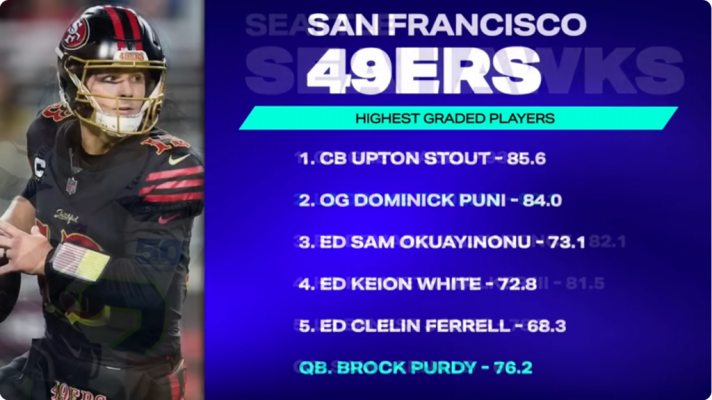
So - the statas matter less than what the QB actually did on the field. Purdy's INT wasnt hung on him, it was put on CMC.
Also, PFF accounts for missed opportunities and missed throws:
Pro Football Focus (PFF) grades do account for missed opportunities by the quarterback.
PFF's grading system aims to evaluate each player's individual performance on a given play, independent of the final outcome or the performance of their teammates.
Here is how PFF accounts for these situations:
- Positive Grading for Accurate Throws: A quarterback who makes an accurate, catchable throw to a receiver who subsequently drops the ball will still receive a positive grade for the play, while the receiver gets a negative grade.
- Negative Grading for Missed Shots: Conversely, a quarterback who misses an opportunity to hit a wide-open receiver downfield will receive a negative grade because they failed to execute their assignment effectively, regardless of whether the play resulted in a minor gain or an incompletion.
- Grading the Process, Not the Result: PFF evaluators focus on the quality of the throw, the decision-making, and the execution, rather than the raw statistics or the final result (e.g., a 70-yard touchdown run resulting from a routine dump-off might only receive an average QB grade).
This process helps PFF isolate a quarterback's true performance level from the surrounding factors, such as receiver drops, great defensive plays, or a running back breaking several tackles on an easy pass.
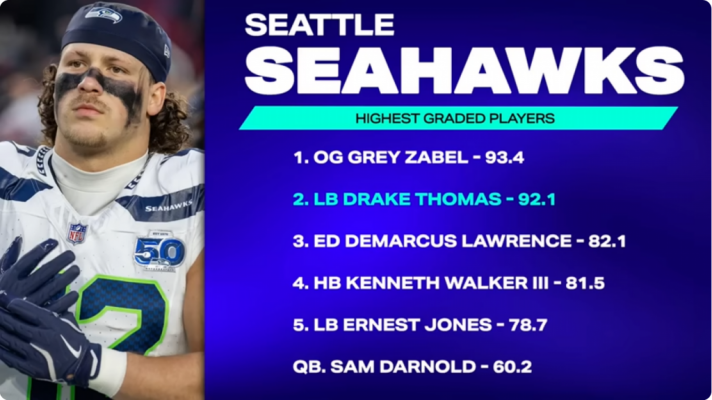
So i think what its saying is Purdy didnt have the stats but also didnt make unforced errors. His numbers reflected the fact that he had few opportunities. Darnold on the other hand had the stats, but was maybe lucky in getting away with bad throws that could have been TOs, missed throws that could have accounted for points, and had a fumble that wasnt lost, but could have been.
It isnt perfect by any means and i think Sam's grade is low, but it is one of, if not the only system that actually attempts to grade the overall performance of a player, stats, and play results aside.